

Medical device compliance is not a constraint on market entry — it is the strategy that makes market entry sustainable. In highly regulated industries, expansion into complex markets is often framed as a trade-off between growth and compliance. In reality, the opposite is true. The manufacturers that succeed in challenging regions are those that treat compliance not as a constraint to navigate, but as the foundation of their market entry strategy.
Over the past decade, regulatory expectations under frameworks such as EU MDR and ISO 13485 have evolved significantly. They no longer focus solely on product safety and documentation, but on the integrity of the entire value chain: from manufacturing and distribution to post-market surveillance and financial conduct. Entering new markets without aligning to these expectations is no longer just risky; it is structurally unsustainable.
From Market Access to System Integrity
Traditional approaches to distribution often emphasize speed: how quickly a product can be registered, imported, and sold. While this may create short-term access, it rarely holds up under scrutiny.
A compliance-driven model starts with a different question:
Can this market entry withstand audit, inspection, and long-term regulatory review?
This requires designing a system where every element—regulatory, operational, and financial—is aligned with international standards from the outset. In practice, this means that local distribution partners must function as an extension of the manufacturer’s quality and compliance system, not as an external commercial entity operating independently.
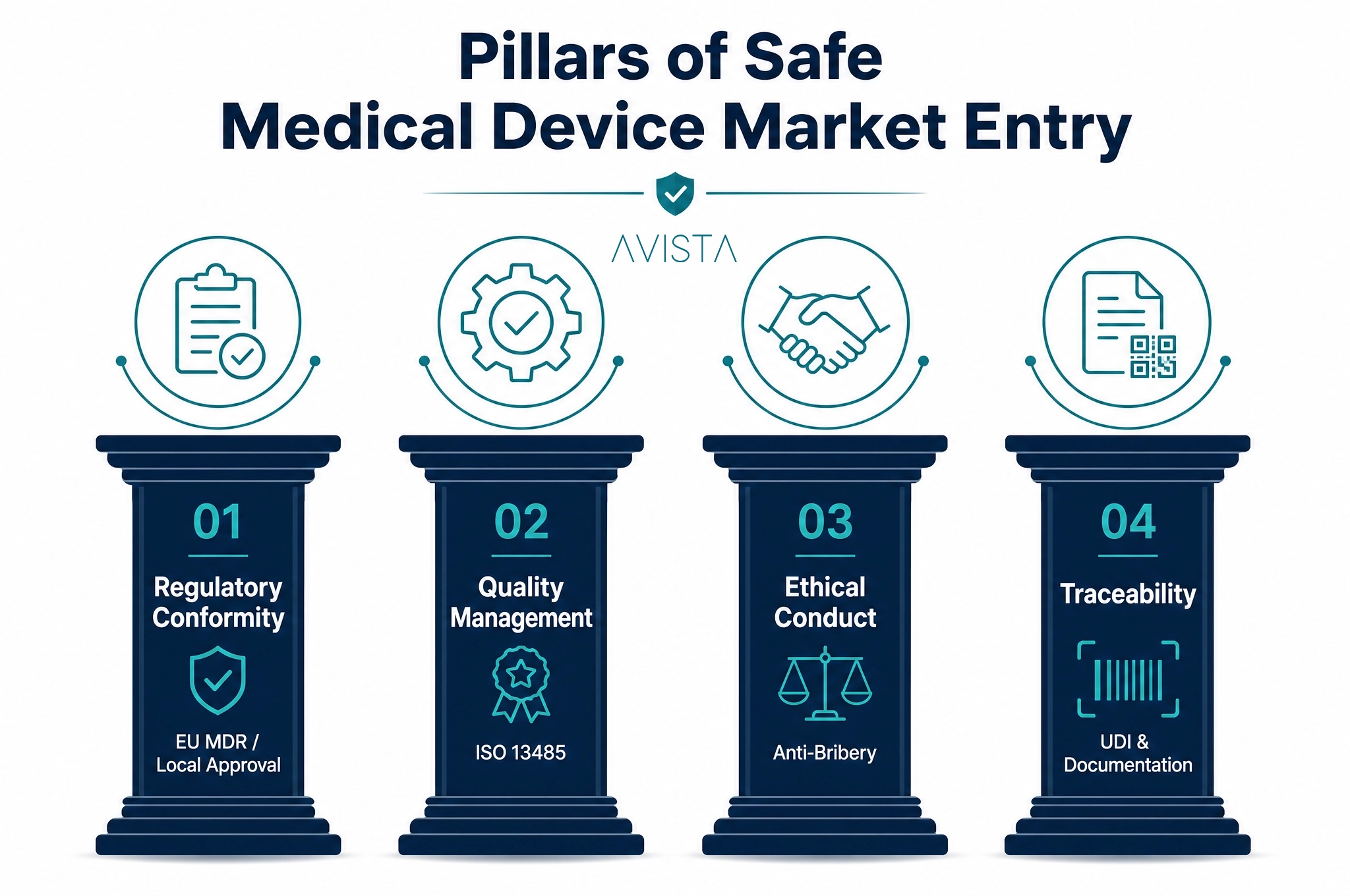
Aligning with EU MDR and ISO 13485 Expectations
Under EU MDR, manufacturers retain ultimate responsibility for their products throughout the lifecycle, including distribution and post-market performance. This has direct implications for how partners are selected and managed.
Key expectations include:
- Controlled distribution channels, with clearly defined responsibilities
- Robust post-market surveillance, including complaint handling and vigilance reporting
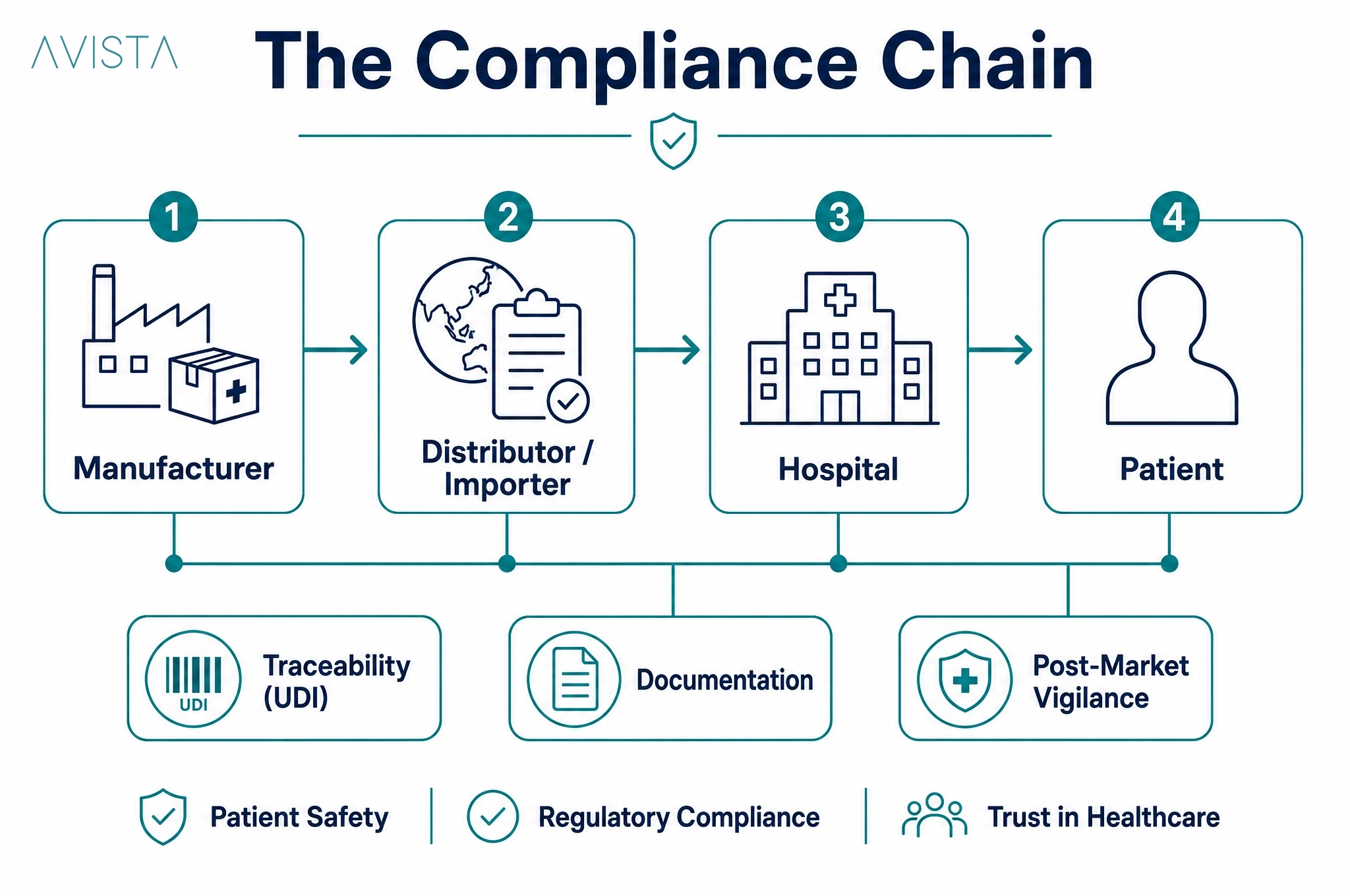
- Documented traceability, ensuring every device can be tracked from import to end use
Similarly, ISO 13485 emphasizes the need for a quality management system that extends beyond the factory floor. Distribution, storage, installation, and servicing must all be performed under controlled, documented conditions. (How this plays out operationally after installation is covered in our article on why most MedTech value is delivered after installation.)
In complex regions, this requires more than contractual alignment. It requires operational capability on the ground; teams that understand not only local regulations, but also international compliance expectations.
Anti-Bribery and Ethical Frameworks: Non-Negotiable Foundations
For global manufacturers, regulatory compliance is closely tied to ethical conduct. Frameworks such as MedTech Europe Code of Ethical Business Practice, as well as international anti-corruption standards (e.g., FCPA-aligned principles), place strict limits on how interactions with healthcare professionals and institutions are conducted.
In practical terms, this means:
- No informal or undocumented financial arrangements
- Transparent contracting with hospitals and physicians
- Clear separation between education, marketing, and commercial activity
- Full documentation of sponsorships, training, and value transfers
In markets where informal practices may still exist, the role of the distributor becomes critical. The right partner does not “adapt” to local norms at the expense of compliance; they establish a structure that protects the manufacturer’s global standards while operating effectively within the local system.
Traceability: Knowing Where Every Device Is
Traceability is often discussed in regulatory terms, but its practical importance becomes clear during audits, field safety corrective actions, or adverse event investigations.
A compliant system must be able to answer, without ambiguity:
- Where was the device imported?
- Which hospital received it?
- Which patient was it used on?
- Under what conditions was it stored and transported?
This requires:
- Structured inventory management systems
- Integration of UDI (Unique Device Identification) where applicable
- Controlled documentation at every transfer point
Without this level of traceability, even a well-designed product can become a liability.
Auditability: Building Systems That Can Be Verified
Audit readiness is not something that can be assembled retrospectively. It must be built into the system from the beginning.
This includes:
- Documented standard operating procedures (SOPs) for all activities
- Training records for all personnel involved in handling the product
- Maintenance and calibration logs for equipment
- Clear documentation trails for regulatory submissions, approvals, and changes
In practice, auditability comes down to one principle:
If it is not documented, it does not exist.
Distributors operating in complex markets must therefore function with the same level of documentation discipline expected of manufacturers in highly regulated environments.
Financial Transparency: The Overlooked Risk Layer
One of the most sensitive aspects of operating in complex regions is financial flow. Payments, pricing structures, and commercial arrangements must be fully transparent and defensible under audit.
This means:
- Clear pricing structures, with no hidden discounts or informal adjustments
- Traceable payment pathways, ideally through recognized banking channels
- Alignment between invoices, shipments, and regulatory documentation
- Separation of commercial transactions from educational or clinical support activities
Financial opacity is often the weakest point in otherwise compliant systems. Addressing it requires not only robust internal controls, but also partners who are willing to operate within a fully transparent framework.

Building for the Long Term
Entering a complex market is not a transactional exercise. It is the establishment of a long-term presence within a regulatory and clinical ecosystem.
Manufacturers that approach this strategically invest in structured onboarding of distribution partners, ongoing training and alignment with global compliance standards, and continuous monitoring of performance, both clinical and operational. (On the clinical side, this is where experienced clinical specialists become part of the compliance equation, not just the procedural one.)
This may slow initial entry, but it creates a foundation that can support sustained growth without exposing the organization to regulatory or reputational risk.
Closing Perspective
Compliance, when viewed narrowly, can appear as a series of constraints. When understood properly, it becomes a framework for control, consistency, and trust.
In complex regions, this distinction is critical.
The question is not how to enter the market despite compliance requirements, but how to design a system where compliance is the mechanism that makes market entry viable—safely, transparently, and sustainably.
For manufacturers operating under EU MDR and ISO standards, this is no longer optional. It is the strategy.
Frequently Asked Questions
What does EU MDR require from distributors?
Under EU MDR, manufacturers remain responsible for their devices throughout the lifecycle, so distributors must operate as an extension of the manufacturer’s quality system — with controlled channels, vigilance reporting, and full traceability.
What is UDI and why does it matter?
UDI (Unique Device Identification) is a system for identifying each device so it can be tracked from import to end use. It is what allows audits, recalls, and adverse-event investigations to be answered without ambiguity.
How does ISO 13485 apply outside the factory?
ISO 13485 extends quality management beyond manufacturing: distribution, storage, installation, and servicing must all happen under controlled, documented conditions.
Why is financial transparency a compliance issue?
Opaque pricing, informal discounts, or untraceable payments are often the weakest point of otherwise compliant systems — and a direct exposure under anti-bribery frameworks such as FCPA-aligned principles.
Avista operates as a fully compliant distribution partner in the region — with documented traceability, transparent financial structures, and alignment with EU MDR and ISO 13485 expectations. Talk to our team about structuring a safe market entry.